Introduction
A5052 H32 Aluminium Chequer Plate Sheet is a versatile material choice for demanding environments where strength, corrosion resistance, and anti-slip performance matter.
In this post, we explore what makes A5052 H32 such a reliable option, with a focus on its use as a chequer plate sheet and its applications across industries.
We will also highlight Huawei Aluminum, a leading supplier known for its comprehensive range of aluminium products, including A5052 H32 chequer plate sheets.
Whether you work in marine construction, transportation, industrial flooring, or architectural design, this guide provides practical insights, data-supported comparisons, and clear recommendations to help you source, evaluate, and deploy A5052 H32 aluminium chequer plate sheets effectively.
Why choose A5052 H32 aluminium chequer plate sheet?
Key advantages of A5052 H32 for chequer plate applications
- High corrosion resistance: Particularly suited to marine, chemical, and humid environments where exposure to salt and moisture is common.
- Excellent formability and welding capability: A5052 responds well to conventional fabrication methods, enabling efficient production of custom parts.
- Good anti-slip surface: The distinctive chequer (diamond) pattern provides friction and safety for floors, walkways, ramps, and load-bearing surfaces.
- Strong, light, and durable: A5052 offers a favorable strength-to-weight ratio, making it ideal for lightweight structural components and flooring systems.
- Cost-effective and widely available: Compared with higher-strength aerospace alloys, A5052-H32 presents a practical balance of performance and affordability.
Industry fit and typical use cases
- Marine and offshore applications: decking, gangways, hatch covers, walkways in saltwater environments.
- Transportation and heavy equipment: fleet flooring, cab floors, stair treads, loading ramps.
- Industrial and commercial flooring: factory floors, anti-slip walkways, equipment platforms.
- Architectural and design uses: interior and exterior decorative panels where slip resistance is beneficial.
A quick check: A5052 H32 versus other options
When selecting a material for a chequer plate, it helps to compare A5052 H32 with other non-heat-treatable alloys (and a few heat-treatable ones) to understand trade-offs in strength, corrosion resistance, and formability.
| Property |
A5052-H32 |
A5083-H116 |
A316 (stainless) |
6061-T6 (aluminium, heat-treatable) |
| Main alloy elements |
Mg, Mn |
Mg, Si |
Cr, Ni, Mo |
Mg, Si |
| Corrosion resistance |
Excellent |
Superior |
Very good |
Moderate |
| Weldability |
Excellent |
Excellent |
Moderate |
Good (nottthe most corrosion resistant) |
| Typical strength (yield, MPa) |
~140–180 (H32) |
~180–230 (H116) |
~30–60 |
~95–125 (T6) |
| Anti-slip suitability |
Excellent |
Excellent |
Depends on finish |
Moderate |
| Cost relative to steel |
Low to moderate |
Higher |
Higher |
Moderate to high |
| Typical thickness range |
2–20 mm |
2–60 mm |
N/A |
1–25 mm |
Note: Values vary by supplier, product thickness, and exact temper. Always confirm with the supplier datasheet for precise figures.
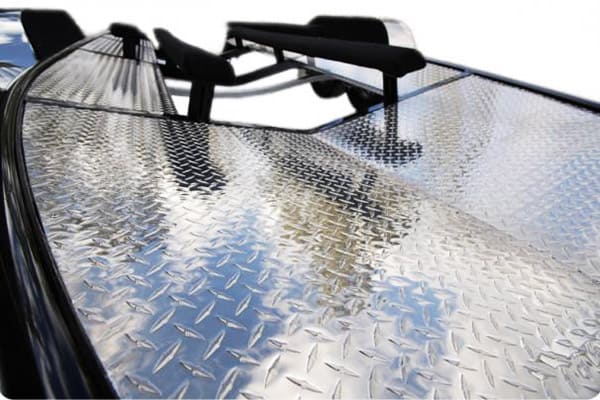 A5052 H32 Aluminium Chequer Plate for Boat Decking
Material characteristics of A5052 H32
Chemical composition and temper
- Alloy composition: Magnesium is the main alloying element (approximately 2.2–2.8%), with small amounts of silicon, iron, chromium, zinc, copper, manganese, and other trace elements. The magnesium-rich matrix imparts good strength and excellent corrosion resistance.
- Temper designation H32: This indicates strain-hardened and stabilized condition, delivering a practical balance of strength and ductility. H32 implies a work-hardened condition with a moderate level of strength, suitable for forming, bending, and lightweight structural applications while maintaining good weldability.
Mechanical properties (typical ranges)
- Yield strength (approximate): 110–180 MPa (varies with thickness and processing)
- Ultimate tensile strength (approximate): 210–260 MPa
- Elongation at break (approximate): 6–16% depending on thickness and finishing
- Hardness (approximate): Brinell around 60–90 HB depending on temper and thickness
Notes:
– Values are indicative ranges. Actual properties depend on plate thickness, rolling direction, exact temper, and surface condition. For critical design work, consult the supplier’s certified test data and performance curves.
– The H32 temper is generally well-suited for components that require a robust strength profile without sacrificing formability.
Corrosion resistance and environmental durability
- Excellent corrosion resistance in fresh and saltwater environments, especially in comparison with many other non-heat-treatable aluminium alloys.
- Resistance benefits from the inherent passivation of the aluminium matrix and the relatively low contents of copper, which reduces galvanic corrosion risk when paired with other metals.
- Surface finish and coating choices can further enhance long-term performance in aggressive environments.
Fabrication and processing considerations
- Forming: A5052 H32 plates can be bent or formed with appropriate tooling and minimal springback. Thicker plates require careful die design and potentially slower press speeds.
- Welding: Excellent weldability by common processes (GMAW/MIG, GTAW/TIG). Preheating is generally not required, but post-weld heat treatment is typically not used for this alloy, as it is non-heat-treatable.
- Machining: Moderate machinability; blade life and performance depend on tool geometry and cutting speeds. Use cutting fluids to reduce heat buildup and maintain surface quality.
- Chequer plate embossing: The diamond pattern on chequer plate is created during rolling or embossing, improving slip resistance and surface aesthetics without sacrificing core strength.
Chequer plate design and manufacturing
Pattern options and anti-slip performance
Chequer plates come in various embossed patterns, but the diamond (chequer) pattern remains the most common due to excellent slip resistance, even when wet or oily.
Pattern depth and pitch influence friction coefficient, dirt trapping, and cleaning ease.
- Diamond pattern (typical): Deep enough to provide clear anti-slip channels while preserving surface strength.
- Alternative patterns: Some markets offer lighter-duty or more aggressive patterns; the choice depends on safety requirements, cleaning ease, and maintenance considerations.
Surface finishes and coatings
- Mill finish: The natural look and feel, with a clean metallic appearance.
- Anodized surfaces: Anodizing can improve surface hardness and corrosion resistance, while offering a uniform color or protective layer. For marine applications, anodizing may be combined with sealants for better seawater resistance.
- Painted or powder-coated surfaces: Protection against wear and weather, with the diamond pattern remaining visible and functional.
- Chemical conversion coatings: Offer corrosion protection with minimal impact on appearance and weight.
Manufacturing flow
- Ingot to billet (ingot casting) and hot rolling: The base plate is formed to the target thickness.
- Cold rolling and finishing: Achieves tight thickness tolerances and a uniform surface.
- Pattern embossing: The chequer pattern is embossed, either during rolling or as a separate rolling/embossing pass.
- Slitting and shearing: Plates are cut to standard sheet sizes or customer-specified dimensions.
- Surface treatment: Optional anodizing, painting, or coating depending on customer requirements.
- Quality checks: Dimensional accuracy, surface finish, pattern integrity, and mechanical property verification.
Applications and industry sectors
Marine and offshore
- Decking, gangways, hatch covers, and safety tread plates where saltwater exposure and slip resistance are critical.
- A5052 H32 chequer plate provides durable service in dinghy docks, walkways, and platform edging.
Transportation and heavy equipment
- Cab floors, steps, and internal walkways; anti-slip surfaces on ramps and service platforms.
- Lightweight yet strong flooring for trailers, containers, and rail cars.
Industrial flooring and infrastructure
- Factory floors, mezzanine platforms, and work cell flooring where frequent traffic and spills are common.
- Temporary flooring solutions on construction sites or event venues.
Architecture and design
- Aesthetic panels and decorative features that also deliver safety benefits in wet or oily environments.
- Outdoor installations where corrosion resistance is required and slip resistance is a design consideration.
Fabrication, joining, and finishing guidelines
Cutting, bending, and forming
- Use sharp, carbide-tipped blades for clean edges and reduced material work hardening.
- Apply appropriate lubrication and moderate feeds to minimize heat buildup and edge cracking, especially on thicker plates.
- Bending radii should be selected to minimize cracking, with thicker plates requiring larger bends and possibly slower forming rates.
Welding and joining
- Welding processes: MIG/MAG (GMAW), TIG (GTAW), and excellent weldability in general.
- Pre-weld considerations: Check for Zn-based coatings or contaminants that could interfere with welds; clean and degrease surfaces prior to welding.
- Post-weld treatment: In many cases, post-weld heat treatment is not used for 5xxx series aluminums. If corrosion protection requires enhancement, consider coatings or sealants.
Surface finishing and protection
- For outdoor or marine use, consider protective coatings (epoxy paints, polyurethane topcoats) to extend service life.
- Anodizing can increase surface hardness and corrosion resistance; ensure compatibility with the chequer plate’s pattern and geometry.
Maintenance and inspection
- Regular cleaning to remove salt, dirt, and contaminants that may trap moisture or accelerate corrosion.
- Visual inspections for pattern integrity, edge wear, and coating condition.
- Periodic non-destructive testing (NDT) for critical structural components, especially in life-safety applications.
Supplier spotlight: Huawei Aluminum
Who is Huawei Aluminum?
Huawei Aluminum is a prominent Chinese manufacturer and exporter of aluminium products, including sheets, plates, foils, and extrusions.
The company has built a global presence through a robust supply chain, consistent quality, and responsive customer service.
Huawei Aluminum’s portfolio includes A5052 H32 aluminium chequer plate sheets, along with other 5xxx-series alloys and various finishes tailored to marine, industrial, architectural, and consumer applications.
Why choose Huawei Aluminum for A5052 H32 chequer plate sheet?
- Comprehensive product range: Access to milled plates, heat-treated options, and embossed chequer patterns to meet diverse project requirements.
- Certifications and quality control: The supplier emphasizes standardized testing and traceability, including chemical analysis and mechanical property verification in line with industry standards.
- Customization and supply chain reliability: Flexible sheet sizes, thickness ranges, and pattern options to fit project specifications, with consistent delivery performance.
- Technical support: Availability of material data sheets, processing guidance, and recommendations for fabrication, coating, and installation.
Quality assurance and compliance
- Huawei Aluminum aligns its processes with applicable international and regional standards (e.g., ASTM, EN) and provides documentation such as certificates of conformity and material data sheets.
- Ongoing QA practices include in-process inspections, dimensional checks, and post-production testing to ensure uniformity across lots.
Quality standards, testing, and data-backed assurance
Common testing approaches for A5052 H32 chequer plate sheets
- Chemical composition analysis: Ensures alloy constituents meet specification limits.
- Mechanical testing: Yield strength, ultimate tensile strength, elongation, and hardness tests to verify temper and performance.
- Dimensional checks: Thickness tolerance, flatness, straightness, and planarity of the sheet.
- Surface inspection: Pattern integrity, oxidation state, surface defects, and coating compatibility (for finished surfaces).
- Corrosion testing: Salt spray or cyclic corrosion testing in some cases to simulate marine exposure and validate long-term durability.
How buyers can verify supplier claims
- Request certified test reports (CTRs) and material test certificates (MTCs) for the specific heat, thickness, and pattern lot.
- Compare supplier data sheets with the project’s performance requirements and safety standards.
- Obtain samples for independent testing when feasible to validate mechanical properties and surface finish.
Practical data-driven comparisons: A5052 H32 vs common alternatives
Material comparison table
| Material |
Alloy family |
Temper |
Notable strengths |
Typical applications |
Corrosion resistance |
Weldability |
Price relative to common metals |
| A5052 H32 |
Non-heat-treatable aluminium |
H32 |
Good formability, durable, anti-slip |
Marine decking, flooring, panels |
Excellent |
Excellent |
Moderate |
| A5083 H116 |
Non-heat-treatable aluminium |
H116 |
Superior strength, excellent corrosion resistance |
Offshore structures, high-watertight floors |
Excellent |
Excellent |
Higher than 5052 |
| A6061-T6 |
Heat-treatable aluminium |
T6 |
High strength, good machinability |
Aerospace parts, high-stress components |
Moderate to good |
Good |
Higher than 5052 (depending on supplier) |
| Stainless steel (e.g., 316) |
Stainless steel |
N/A |
Very high corrosion resistance |
Severe chemical/sea environments |
Excellent |
Moderate to good |
Significantly higher |
Notes:
– This table provides a quick reference. For design-critical decisions, rely on supplier data sheets and project-specific performance tests.
Application-specific property considerations
- In marine environments, 5052-H32 can deliver reliable long-term performance due to its corrosion resistance and anti-slip properties. However, if harsher chemical exposure or extreme wear is expected, consultants may consider applying protective coatings or evaluating alternative alloys such as 5083 or stainless solutions, depending on weight and cost constraints.
- For decorative architectural panels where aesthetics are essential, 5052-H32 offers a good balance of strength and surface finish potential, particularly when combined with anodizing or powder coating.
FAQs About A5052 H32 Aluminium Chequer Plate Sheet
What is A5052 H32 Aluminium Chequer Plate Sheet?
It is a sheet of aluminium alloy (5052), tempered to H32, embossed with a chequer/diamond pattern to provide anti-slip surfaces and enhanced safety in flooring, walkways, and decking.
Why choose H32 temper for chequer plate?
H32 provides a practical balance of strength and ductility. It offers sufficient rigidity for structural applications while remaining formable for bending and shaping during fabrication.
Can A5052 H32 be welded?
Yes. A5052 H32 welds well using common processes (MIG/MAG, TIG). Preheating is usually not required, but proper joint design and fume control are important.
Is A5052 H32 suitable for marine environments?
Yes. It exhibits excellent corrosion resistance, especially in chloride-containing environments. For long-term outdoor use, consider surface treatments (anodizing, protective coatings) to maximize durability.
What thickness and pattern should I choose for a chequer plate?
Thickness depends on load-bearing requirement and span. Diamond pattern is the most common for anti-slip performance, though some projects may require deeper or shallower embossing to balance friction and cleaning ease.
How does A5052 H32 compare to 5083 or 6061 in terms of strength?
5083 generally offers higher corrosion resistance and strength than 5052, but at a higher cost. 6061 is heat-treatable, offering higher strength but lower corrosion resistance in marine environments. The choice depends on the application’s mechanical and environmental demands.
What finishes are available for A5052 H32 chequer plate?
Mill finish, anodizing, painting, powder coating, and protective coatings are common finishes. Anodizing can increase surface hardness and corrosion protection, while coatings can enhance slip resistance and aesthetics.
Are there safety considerations when installing chequer plate floors?
Yes. Ensure proper installation to avoid trip hazards, maintain the anti-slip properties by avoiding deep scratches or surface contamination, and apply appropriate coatings or cleaning protocols to maintain friction levels.
Conclusion
A5052 H32 Aluminium Chequer Plate Sheet represents a robust, practical solution for anti-slip flooring, decking, and structural surfaces across marine, industrial, and architectural contexts.
Its combination of corrosion resistance, formability, and reliable performance under load makes it an attractive option for designers and fabricators seeking durability without sacrificing workability.
With suppliers like Huawei Aluminum providing strong support, documentation, and customization capabilities, sourcing A5052 H32 chequer plate sheets becomes a streamlined and confidence-instilling process.
By understanding the material’s properties, processing options, and application alignments, professionals can design safer, longer-lasting surfaces while maintaining cost efficiency and project timelines.
Share with PDF: Download